









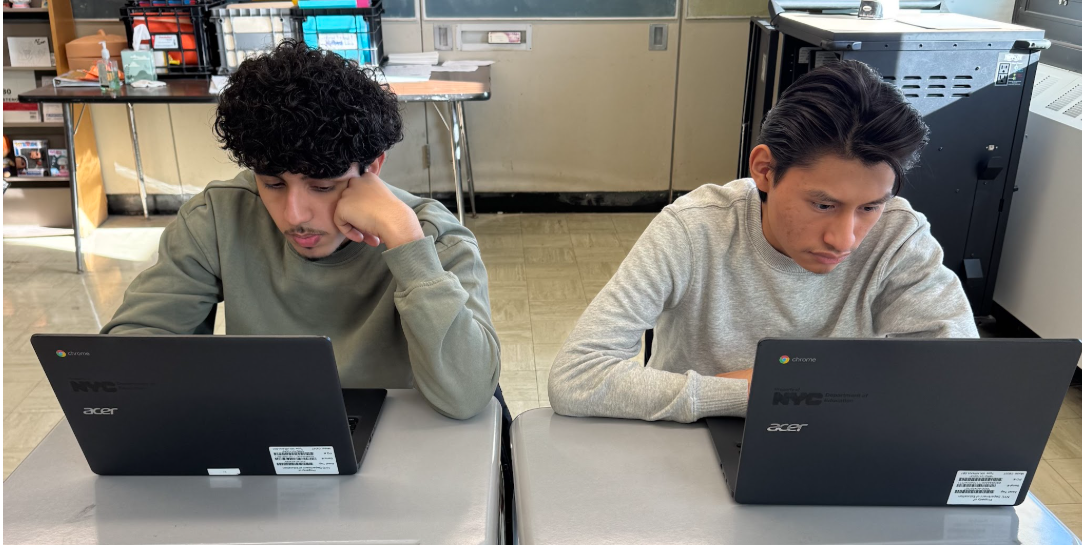
As New York schools grapple with the new statewide phone ban, John Dewey High School in Brooklyn has sought to bridge the digital divide by distributing school-issued Chromebooks; however, not all students are receiving the same access to the technology.
The high school’s initiative aims to equip all students with a necessary digital tool, allowing them to take their devices home to complete assignments and foster digital responsibility.
The move has been widely appreciated by those who benefit from it, particularly students lacking personal computers at home.
“I think that students receiving Chromebooks is a good thing because the students that can’t afford electronic devices can have access to online homework with the help of these Chromebooks,” noted senior Janely Aguilar Gomez, a student who uses the provided technology regularly.
For Aguilar Gomez, the device serves a practical purpose that extends beyond basic word processing. “I use my Chromebook to do my homework and study most of the time,” she said. “But I also do use my Chromebook to read or watch videos during my free periods”.
The Chromebooks have quickly become integral to classroom management, offering a controlled environment for learning.
They are generally seen as a superior tool for focused work compared to the small and non convenient smartphone.
“Chromebooks have replaced phones in the classroom by giving us a more controlled way of learning online,” Aguilar Gomez observed. “Many websites on a Chromebook are monitored, unlike phones, so it’s a lot easier to stay on track and do work.”
This structure has translated into tangible productivity gains for many students. “Yes, my Chromebook has increased my productivity and I am less prone to distractions compared to my phone,” Aguilar Gomez added. “Since my Chromebook doesn’t have many social media apps, I don’t get distracted by my friends or certain notifications.”
The program also helps students prepare for high-stakes assessments, such as the SATs, which are increasingly relying on digital platforms. “As for the SAT, I can use the Chromebook to help me get familiar with the materials that are on the test so I can get a good score,” Aguilar Gomez stated.
Some seniors, however, feel as if they are missing out on the benefits that the underclassmen are receiving.
It is duly noted that seniors at JDHS do have access to technology. However, they have to request it, instead of being offered it like the freshmen.
In addition, when requested, seniors are given iPads instead of Chromebooks, making the tasks that seniors need to complete more difficult, as many students prefer a physical keyboard.
“I was envious because we didn’t get that same treatment as freshmen and now as seniors,” junior Jacques Desir said.
This disparity created significant challenges for Desir, who lacks a laptop at home.
Not being able to take a school device home significantly impacted his study habits, forcing him to complete complex assignments on his phone.
“It affected my study habits because I wouldn’t have my own device to do my work so it would only be on a small device like my phone,” he explained, noting that the small screen and interface made tasks take much longer.
Specific tasks, like working with presentation slides, are particularly difficult.
“I feel like using slides is much harder on a phone rather than a laptop since you have to switch in between tabs and something might get deleted.”
Desir felt at a clear disadvantage compared to his younger peers. “Yes, since I didn’t get the same treatment as a freshman, if I had these benefits, I would be doing my work more consistently and wouldn’t be waiting at the last minute,”
He advocates for a fully equitable distribution system. “I feel like they should have given the laptops or the electronics they have to everyone, since everyone would benefit from all the electronics.”
The program highlights varying preferences for technology. While many students view the Chromebook as a vital educational tool, others, like another interviewee who preferred the iPad ecosystem, declined the offer.
“I have an iPad, they offered me a Chromebook but I didn’t want to get it since I like the iPad better,” junior Jacky Xu said.
However, those who accepted the devices generally see the benefit in managing personal electronic responsibility. The devices are issued with a clear understanding: if they are damaged, the student is financially responsible for repairs or replacement, which seems to motivate responsible use.
The consensus among students is that the initiative, while having room for improvement in equitable distribution, is a positive step towards integrating essential technology into student life and preparing them for a digital future.