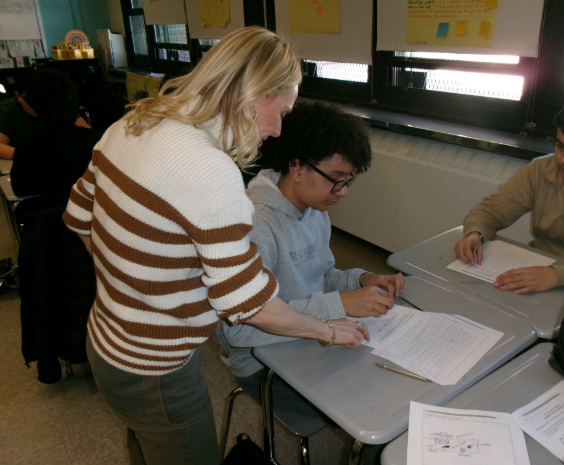





In the span of three minutes, music drifts through the hallways, laughter and chatter among friends echoing off the walls. Footsteps can be heard as students make their way to the nearest exits to end their day. After the wave of commotion, quieter footsteps follow, heading toward Room 341.
This academic year, Dewey’s newly revived Model United Nations club is off to a very ambitious start.
With conferences approaching, members are conducting research, refining their arguments and techniques and preparing for their first competition.
Two students are mainly responsible for reviving the club- seniors Karen Lin and Lila Chen.
Last year in AP Seminar class, Mr. Barkley introduced the idea of reopening Model UN to re-highlight Dewey’s spirit.
Lin and Chen showed passionate interest and offered to help promote the club. Soon, without a doubt, Lin and Chen became co-founders.
When asked what considerations and factors contributed to her and Lin founding Model UN, Chen said “Well it’s a mix of both, in which I did Mock Trial and Karen did Journalism. So we both had that sort of level of dedication and interest also in representing the people’s voice but also law. Since both of us were interested in sort of like the half and half matters of Model UN, we decided to come together and found the club.”
Although Lin jokes about not being to secure the presidency, she described the experiences as genuinely exciting.
What surprised her the most was the club’s consistency, with 15 to 20 students attending regularly. That number was especially surprising as retention and outreach are often difficult to maintain during the winter months.
As an editor-in-chief of Journalism Club and co-founder of Model UN, Lin understands student retention and the struggles often associated with it very well.
Beyond the attendance, Lin says that the in-depth debate style has been her favorite aspect of the club, especially the practice simulations of real conferences.
“We got to use more debate terminology, such as ‘unmoderated caucus,’” Lin said. “That just—I don’t know—it felt very immersive.”
Both Lin and Chen credit Barkley’s enthusiasm in his advisory role as one of the reasons for the clubs success this school year.
“The energy he brings into the room is one of confidence,” said Chen.
As the advisor, he truly believes that Model UN stands apart from other forms of debate.
“I think that what I enjoy most is seeing students really get a bigger understanding of the world that they live in,” said Mr. Barkley. “I think that it’s really cool to see them gain an understanding of maybe a country or a culture that they didn’t even know existed before they joined Model UN, or a country or a culture that they had really no frame of reference for, and see them actually enjoy learning about it and really understanding.”
Additionally, he acknowledges that it’s simple to feel intimidated after witnessing conquering the fear of conferences, comparing yourself to others since many of the competitors are very capable, but the biggest reward is inevitably witnessing the same student enter the hall and realize that their hard work has prepared them for success.
“I think it really helps set them up for understanding not only the world we live in a little bit better, but it sets them up for their future a little bit better, that they’re not just the person who’s like, Well, this is a problem. We should fix it. They’re really thinking about, okay, what would it really take to fix these problems,” said Mr. Barkley.
Chen explained Model UN competitions are structured in two sessions: a morning session and an afternoon session. Each participant represents a country.
In the morning session, delegates speak, observe the tone of the committee, and present their country’s position while gauging the overall direction of debate.
After a break to plan and strategize, the second session allows delegates to question other participants and examine other countries’ policies.
Information gathered during the morning session often shapes arguments made in the afternoon. Each session typically lasts two to three hours, depending on the pace of discussion.
An unmoderated caucus is a motion in which debate goes unregulated: delegates are free to get up from their seats and move around the committee room to discuss with other delegates or work on writing papers.
Despite the strong progress and efforts, funding for future competitions and getting the school to pay continues to be one of the biggest challenges of the year.
“Naturally since we are a club that just recently started, we have very little funding. And so one of the biggest factors was deciding how to sort out with funding and how we can make money to compete. In fact, not a lot of people knew each other’s name, but despite that, we were all able to come together and basically decide on how to fundraise and how the fundraising would work,” said Chen.
For now, as the hallways empty and the after-school quiet settles in, the revived Model UN club continues building toward that vision — one meeting at a time.
“In a year, I hope that we will have more opportunities to compete, and be able to engage in actual debates. We don’t have many opportunities other than this competition we are attending, and go to procedures places. I hope in five years time, when I come to visit Dewey. I can see a trophy display at the front that says Model UN,” said Lin.